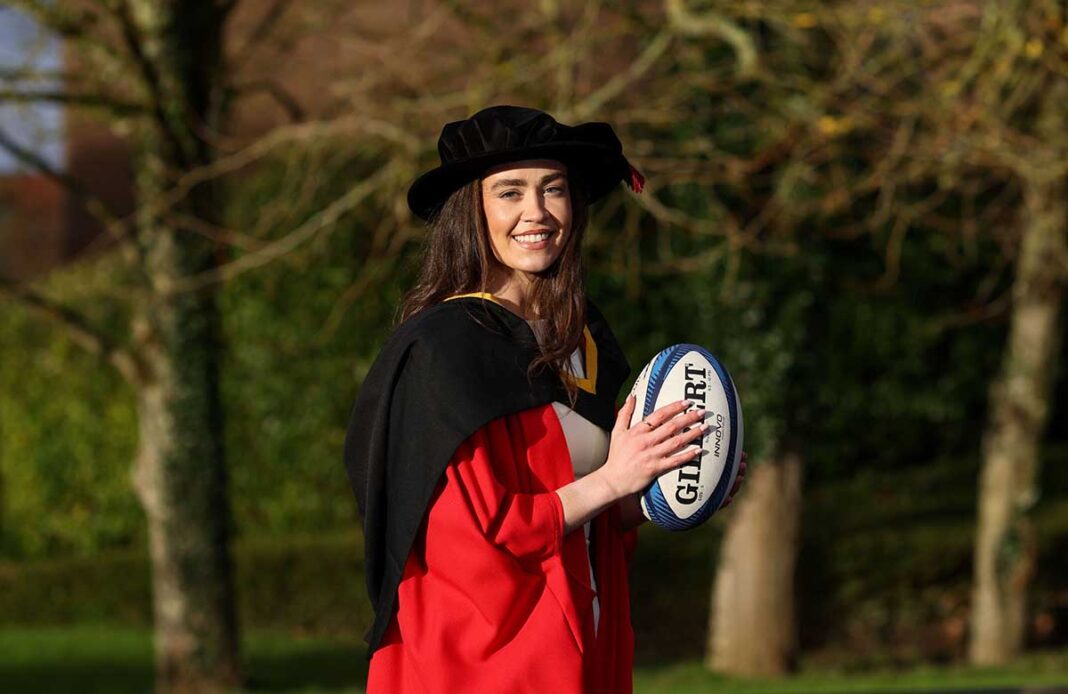
Former sports broadcaster and chartered physiotherapist Lauren Guilfoyle completed a third-level hat-trick at University of Limerick this week, as she received her third degree from the institution.
Lauren has been conferred with a PhD in Youth Rugby Union Injury from UL’s Faculty of Education and Health Science, and is one of 2,038 students being conferred this week as part of UL’s winter conferring ceremonies.
Lauren’s UL journey started 14 years ago when she enrolled in the Bachelor of Science in Physiotherapy. She later returned to study a Master of Science in Sport, Exercise and Performance Psychology, before deciding to begin her research career with her alma mater and start a PhD with the Irish Rugby Injury Surveillance (IRIS) project.
Her project, funded by the Irish Rugby Football Union (IRFU), was based in UL’s Physical Education and Sport Sciences (PESS) department. Lauren’s research focused on injury surveillance and injury prevention intervention implementation in youth rugby players.
Growing up in Feakle, East Clare, sport was everything to the Guilfoyle family. Lauren fondly recalls her childhood, “reared on the side of a GAA pitch”, supporting her father, former senior inter-county hurling star Tommy Guilfoyle, who had a stellar career both playing and coaching hurling at a senior level.
“Growing up, I must have seen every GAA pitch in the country. If we weren’t playing or training, we were going to other games to watch. It fostered a desire in me early to want to work in sport, if I could at all make that possible.”
Immersed in sporting culture, she knew from an early age that she wanted a career in sport someday and choosing to study at UL was an easy decision. The campus, sports facilities and proximity to home made UL her first choice, and once immersed, she became heavily involved with UL GAA during her studies and beyond.
After qualifying as a physiotherapist in 2016, Lauren’s career as a sports broadcaster was in full swing, balancing sports journalism and her work as a chartered physiotherapist in private practice, as well as with Tipperary GAA minor and senior teams.
Over time, as her professional physiotherapy portfolio grew, she realised she wanted to return to study to specialise in sports psychology. “It came down to understanding that you’re working with people who have injuries, you’re not just working with knees and ankles,” she reflected.
Having stepped back from her work in sports media, Lauren’s decision to undertake a career in the research side of sport wasn’t something she saw coming, having never given any thought to doing a PhD before her master’s.
“The master’s really gave me the confidence to move into the research space, and it was my thesis supervisor who floated the idea. Before that, I never even thought it was something that I was able to maybe even consider.”
Her interest piqued, an exciting PhD opportunity kept her at UL, where she accepted a role as a doctoral researcher with the IRIS project at UL, funded by the IRFU.
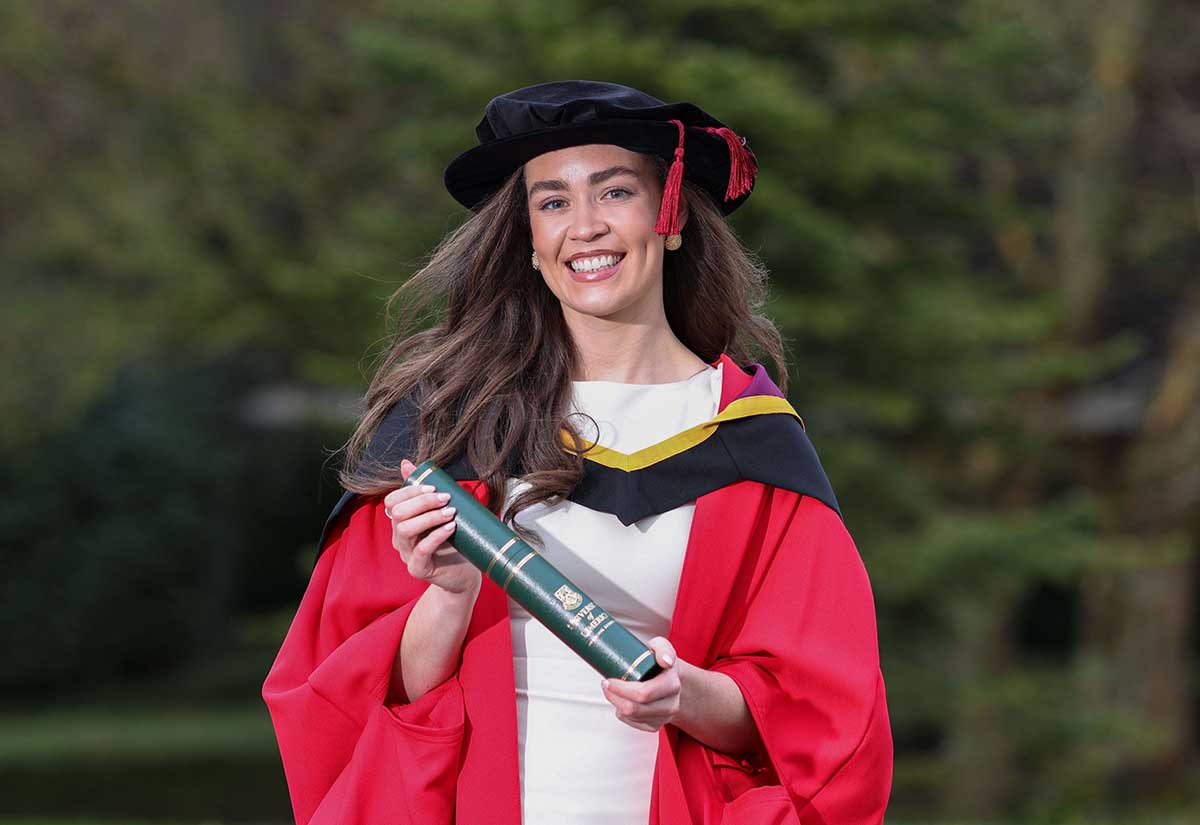
During her PhD, Lauren developed an implementation strategy for a rugby-specific injury prevention programme. Through this project, her research sought to understand the needs and preferences of the coaches who deliver injury prevention programmes to young players. The final study showed significant improvements with 68 per cent of coaches using the injury prevention programme at every available opportunity.
“The biggest personal lesson I learned across my PhD, which I wish I had known sooner, was that my version of productivity does not need to fit into the ‘normal’ box and be contained within the hours of 9:00am and 5:00pm. I really love the flexibility that academia offers, and I’ve embraced that,” explained Lauren.
Reflecting on her impressive career to date, Lauren said: “I think that the reason I’ve chosen the career that I have is that it was my way to get into high-performance sport without being a high-performing athlete.”
Lauren credits her family among the people who have supported her over the years, “There are a lot of people who spring to mind when I think about the small decisions I’ve made, who have helped me get to where I am now,” she said.
Now based in Scotland, Lauren is working as a post-doctoral research fellow at the University of Edinburgh, leading the Retired Female Olympian Health project. With this new project, she hopes to gain an understanding of the long-term potential benefits and consequences of Olympic-level sport on the health of female athletes.
Excited by the new research opportunity, she explained: “There is so much to uncover that can really have an impact on the lives of elite athletes once they retire from sport.”
“Knowledge is power. Being able to help inform these women about what to expect as they age, given what their bodies have been through to reach the top of their sport, is fulfilling for me. It’s an incredible opportunity to work with leading researchers in the field of elite athlete health,” she added
When asked about how she stays so driven, Lauren explained: “My everyday inspiration is fuelled by an intense curiosity. I really love exploring the intersection between sport, health and sociology/culture.
“I want to spend my time working on projects that can work in the real world – and so in comes my interest in the sociological side of sport. Having spent 10 years working in amateur sport, I have accumulated a variety of experiences working with females, adolescents, grassroots versus elite, etc., so I bring an understanding of the real world to my research to ensure it is applicable and impactful.”