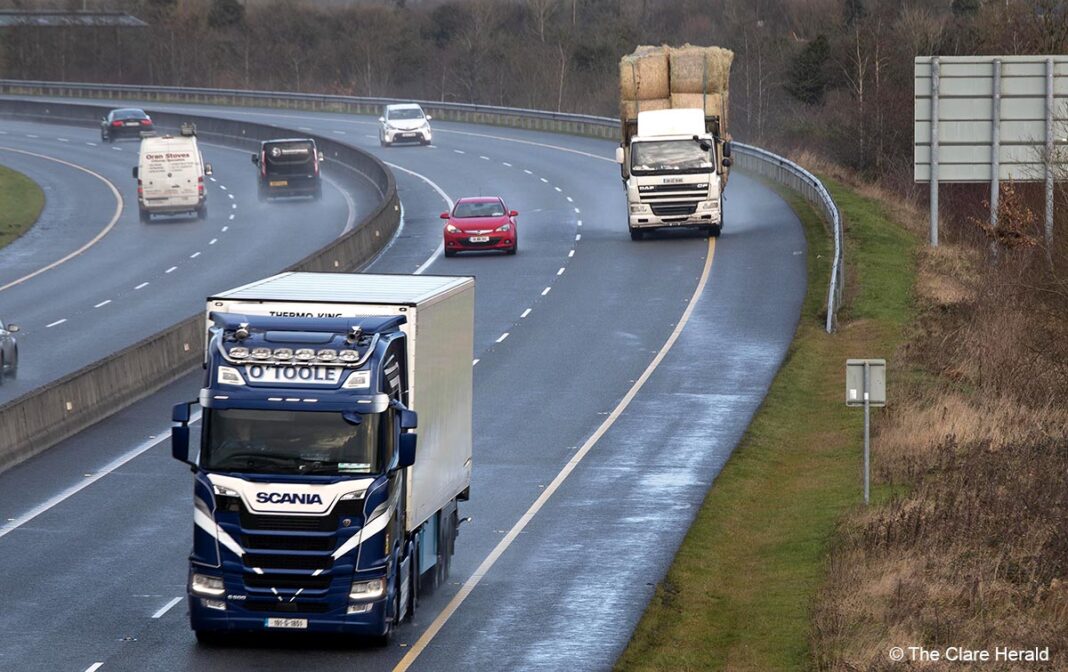
Rural Ireland is being driven off the road by new punishing government imposed fuel taxes, transport charges and levies, with devastating consequences for small family run businesses across rural Ireland.
That is according to Irish Road Haulage Association President Ger Hyland, who has described the current government as being completely out of touch with cost pressures facing rural Ireland.
Hyland was speaking in the wake of a series of new government imposed fuel taxes, new toll charges and fuel levies that kicked in on January 1st and now mean Irish drivers are paying the highest diesel rates in all of the EU.
According to Hyland, “Every extra penny at the pump and every levy on our livelihoods is another nail in the coffin of the haulage industry but also on small business in rural Ireland. Haulage companies are being pushed to the brink, with some already forced out of business, as fuel taxes, increased tolls, new port charges and carbon taxes rise relentlessly. That is also driving the cost of potatoes, milk, bread and other supermarket stapes that are delivered in the back of a truck”
Hyland accused this government of punishing families in rural Ireland who need their cars to get to work, to get their children to school, and to visit elderly parents.
“Government take the easy option every time and hike taxes on transport – which disproportionately impacts on rural Ireland, where there is no viable public transport alternative. The Irish economy is being made uncompetitive by our own government. At a time when international competition is fierce, the State is actively undermining Irish businesses in rural Ireland by loading additional costs onto the transport sector, which underpins every part of the economy”
Mr Hyland described the current government as the most tone deaf government that we have had in 30 years.
“They don’t seem to grasp the damage they are doing to the Irish economy and to rural Ireland in particular. This government do not seem to care that we, as an island nation, need to be competitive”
Fuel taxes hitting motorists and hauliers alike
Motorists are now paying approximately €5 more to fill a tank of fuel than this time last year, and €19 more than five years ago following the latest hikes. That equates to hundreds of euro every year in additional taxes on hard-working Irish families.
From 1 January 2026, further increases will apply:
Under the Renewable Transport Fuel Obligation (RTFO), the blending rate will rise from 25% to 32%, increasing the cost of unleaded petrol by 2.1 cent per litre and diesel by 3.2 cent per litre (excluding VAT).
The Better Energy Levy will increase from €0.012 to €0.017 per litre (excluding VAT) across all fuel grades.
Carbon tax has risen by €7.50 to €71 per tonne of CO₂, adding more than 2.5 cent per litre to fuel costs.
These increases come on top of new charges at Dublin Port, and increased toll charges for all drivers.

Ports, tolls and hidden charges
Dublin Port has added new charges to goods coming into and out of Ireland, amounting to hidden tariffs on the Irish economy. A 5% increase in container prices combined with a new €15 infrastructure charge represents an effective 46% increase per container. These costs will be passed directly on to consumers in what can only be described as a massive act of self-sabotage on Irish trade interests, particularly given Dublin Port’s pre-tax profits rose to €35.9 million last year.
Toll prices are also rising again. The Dublin Port Tunnel toll will increase by €1 during weekday mornings, while HGVs on the M50, M4, M3 and other routes face further increases. Some hauliers are already paying up to €250,000 a year in tolls alone.
Despite regulations requiring toll operators to provide a 10% discount for frequent users, toll operators make it virtually impossible to access this discount by relying on outdated and impractical systems.
Climate Action Must Be Fair
The IRHA absolutely accepts that climate change is real and must be addressed. However, a just transition is essential. One industry – transport – cannot be made responsible for carrying the burden of all climate change measures.