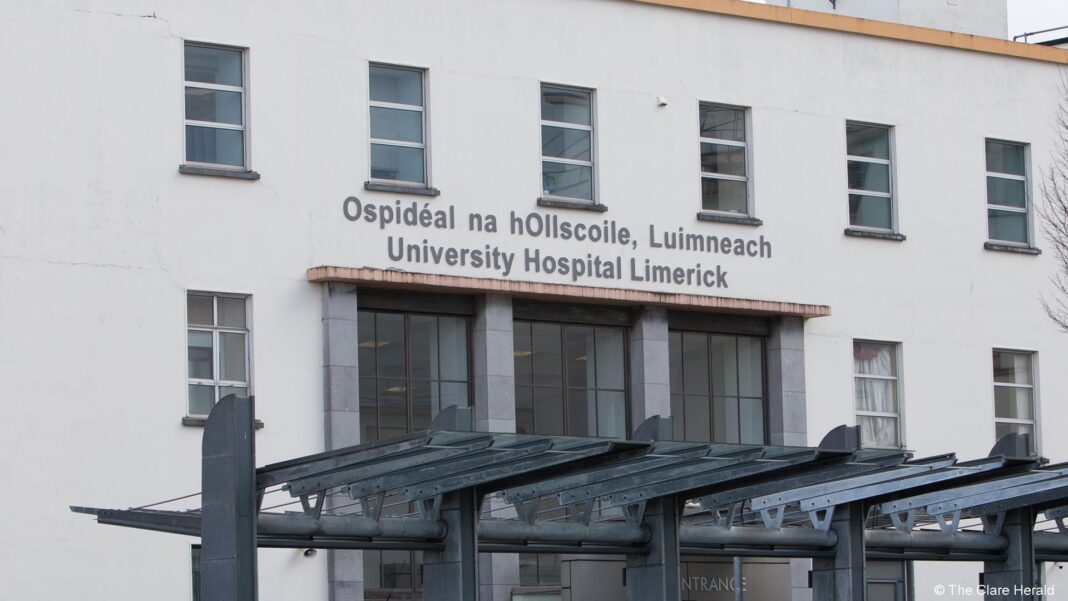
Friends of Ennis Hospital (FEH) has completed a comparative analysis of Ireland’s major Model 4 hospitals using publicly available HSE workforce, activity and capacity data.
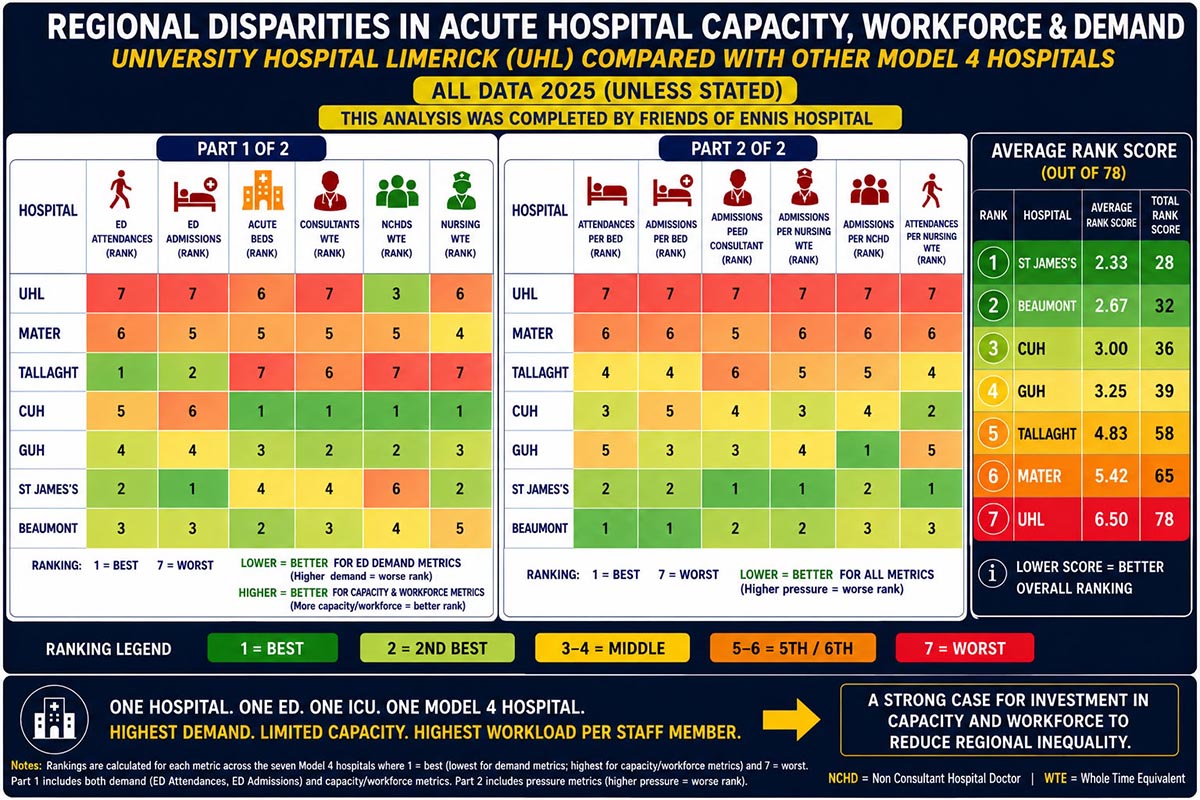
The analysis examined emergency department attendances, emergency admissions, acute bed capacity, consultant staffing, nursing staffing, NCHD staffing and a range of workload indicators across University Hospital Limerick (UHL), Cork University Hospital, Galway University Hospital, Beaumont Hospital, St James’s Hospital, Tallaght University Hospital and the Mater Hospital.
The findings paint a concerning picture of the pressures facing acute services in the Mid-West.
While UHL recorded the highest number of emergency department attendances and admissions among the hospitals examined, it did not have the bed capacity or consultant workforce levels of larger comparator hospitals such as Cork University Hospital.
FEH’s analysis found that UHL had:
The highest emergency department attendances.
The highest emergency admissions.
The highest admissions per acute bed.
The highest admissions per consultant.
The highest admissions per nursing WTE.
The highest admissions per NCHD.
The highest attendances per nursing WTE.
The data indicates that UHL is treating more emergency patients relative to available capacity and workforce than any other hospital included in the analysis.
According to Friends of Ennis Hospital spokesperson Angela Coll: “The data does not lie. When we compare UHL with other Model 4 hospitals, a consistent pattern emerges. Demand is exceptionally high while capacity and workforce have not kept pace.”
“This is not a criticism of the staff working in UHL. In fact, the analysis highlights the extraordinary workload being carried by consultants, nurses, NCHDs and support staff across the hospital every single day.”
The group noted that UHL serves a region that relies on a single Model 4 hospital, a single Emergency Department and a single adult ICU service.
Importantly, FEH said the findings suggest that the Mid-West’s challenges are primarily concentrated within acute hospital services rather than community care.
“One of the most important findings from our work is that the Mid-West’s challenge is not simply a lack of healthcare investment. Community services compare favourably in a number of areas. The persistent weakness lies in acute hospital access, acute bed capacity and acute workforce provision.”
FEH acknowledged the recent acquisition of the site at Raheen for the future replacement of University Hospital Limerick but expressed concern at the pace of progress since the announcement.
The group noted that while the purchase of a site is an important milestone, there remains no Hospital Development Board in place to oversee delivery of the project and no published timeline for construction.
“The acquisition of a site is welcome, but a site is not a hospital. The people of the Mid-West need to see tangible progress, including the establishment of a Hospital Development Board and a clear roadmap for delivery.”
FEH said that even if the proposed hospital in Raheen proceeds, the data increasingly demonstrates that additional acute capacity will be required elsewhere in the region.
“The debate cannot simply be about replacing one hospital in Limerick with another hospital in Limerick. The Mid-West is one of the fastest growing regions in the State and demand is already outstripping capacity.”
“The data does not lie. The Mid-West needs more than replacement capacity. It needs additional capacity. Equity will only be achieved when healthcare planning reflects the geography, population growth and future needs of the entire region.”
“Raheen is necessary. Raheen alone is not sufficient. County Clare is the fastest-growing part of the Mid-West. If we fail to plan now for additional acute capacity outside Limerick City, we will simply recreate tomorrow’s crisis on a larger scale,” Ms Coll concluded.