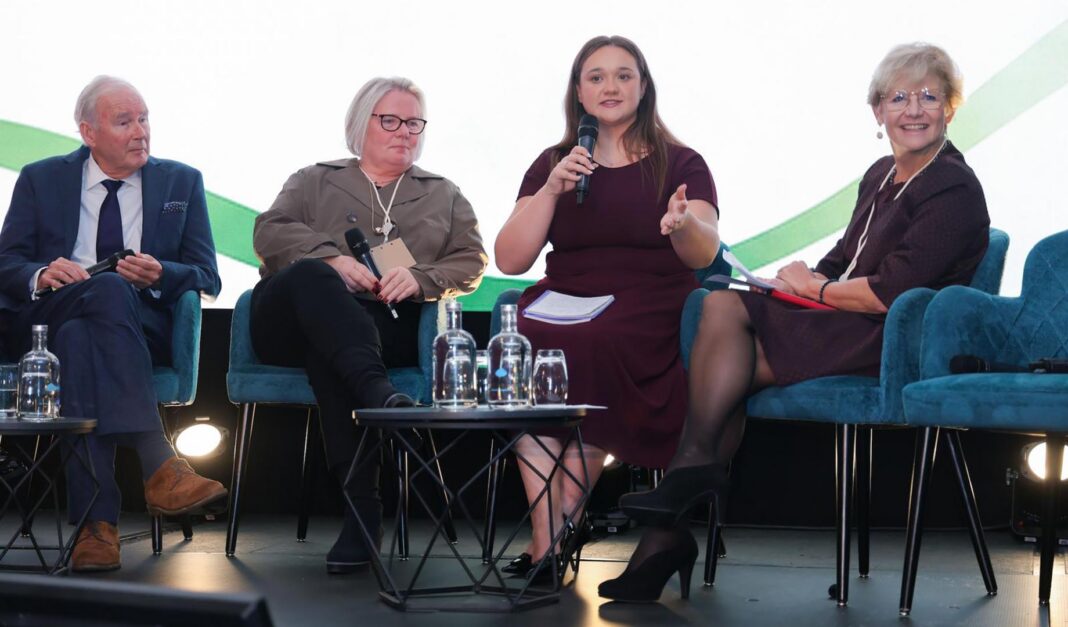
Clare Fianna Fáil Councillor, Rachel Hartigan, has told a European heart health conference that urgent action is needed on inherited heart disease.
Cllr Hartigan was a panelist at the FH Europe annual conference, which was held in Dublin this year, where she spoke about her efforts to push for the publication of a new National Cardiovascular Policy & Strategy and other cardiac health initiatives, following her partner’s heart attack at the age of 29 due to undiagnosed familial hypercholesterolemia (FH).
Familial hypercholesterolaemia is an inherited condition which causes exceptionally high levels of LDL cholesterol from birth. Without early diagnosis and appropriate treatment, people with FH face a significantly increased risk of developing premature cardiovascular disease, which can lead to events such as heart attacks and strokes.
It is estimated that approximately one in every 250 people has FH, meaning that as many as 20,000 people in Ireland could be living with the condition, the majority of which are undiagnosed. Without early screening and treatment, the condition carries up to a 50% risk of a heart attack before the age of 50 in men.
Speaking to an international audience of patient advocates, healthcare professionals and representatives working in cardiovascular health, Cllr Hartigan highlighted the urgent need for Ireland to translate the European Commission’s Safe Hearts Plan into meaningful national action.
Drawing on both her local perspective and the personal experience of her partner, Ben, she outlined how earlier identification of inherited cholesterol conditions could prevent devastating cardiovascular events, reduce pressure on the health service and save lives.
Cllr Hartigan said: “Ireland has a real opportunity to make significant progress in preventing cardiovascular disease, and familial hypercholesterolaemia is an area where we could make an enormous difference.
“What makes FH particularly concerning is that someone can be completely asymptomatic while serious cardiovascular damage is developing. We cannot expect young people to identify a risk that they don’t know they have. We need to be much better at identifying inherited risk before symptoms develop, rather than waiting until somebody presents to hospital with a heart attack.
“The success of any strategy must be measured by the real difference it makes to patients and families, not simply by the publication of another policy document or the announcement of another initiative.”
A particularly important part of Cllr Hartigan’s contribution was sharing the experience of her partner, Ben Sweeney, who suffered a heart attack in January 2026 before undergoing quadruple coronary artery bypass surgery
According to Cllr Hartigan: “His experience demonstrates the importance of early screening and the need for a more systematic approach to identifying inherited cholesterol conditions among young people.
“Instead of a heart attack, major surgery and everything that comes with it, there was an opportunity to identify his risk at a young age and manage it with medication and regular monitoring.
“Ben was very fortunate that his circumstances represented the best case scenario outcome of someone who survived his heart attack and was able to get lifesaving surgery, but a lot of people aren’t as fortunate and thousands of lives are lost unnecessarily to cardiovascular disease every single year in Ireland.
“Ben’s experience is not just a personal story. It illustrates exactly why early detection matters. We should not be waiting for young people to have heart attacks before we recognise that something is seriously wrong.”
The need for greater action is reinforced by the available Irish cardiovascular health statistics, which say that up to 20,000 people in Ireland are estimated to have FH, that 40,000 new cases of cardiovascular disease occur in Ireland each year, and that almost 10,000 people died from diseases of the circulatory system in Ireland in 2024.
Cllr Hartigan said these figures underline why prevention must become a much stronger priority within Ireland’s healthcare system.
“We are already seeing the consequences of cardiovascular disease in our hospitals and communities. However, when it comes to FH, we have a particular opportunity because we know what causes the condition, we know how to identify it, and we have effective treatments available.
“This is not about inventing a new medical solution. It is about making sure that the people who need existing treatments are identified early enough to benefit from them.
During her address, Cllr Hartigan outlined three key priorities which she believes must underpin Ireland’s response to FH and inherited cardiovascular disease; earlier detection and systematic screening, a coordinated national FH pathway, and clear accountability and liability in implementing a national strategy.
Cllr Hartigan called for a systematic, evidence-based approach to identifying people at risk of FH, with a particular focus on young people and inherited risk.
This should include:
Better assessment and recording of family medical histories in general practice.
Greater awareness among GPs of the indicators of inherited high cholesterol, particularly exceptionally elevated LDL cholesterol in younger patients.
Consideration of targeted and systematic lipid screening for people at increased inherited risk.
Earlier identification of individuals before cardiovascular symptoms or damage develop.
Cllr Hartigan emphasised that screening must be informed by evidence and clinical guidance, rather than relying on people to request cholesterol tests themselves.
She also called for a properly coordinated pathway for patients identified as potentially having FH.
This should include:
Clear referral criteria from GPs to specialist lipid clinics.
Improved and more equitable access to specialist lipid services, including for patients living outside Dublin.
Greater access to genetic testing where clinically appropriate.
Systematic cascade screening and testing for relatives of people diagnosed with FH.
Appropriate education and support to help patients understand their condition, adhere to medication and attend regular monitoring.
She also highlighted the importance of ensuring that a diagnosis is not the end of the process.
“Identifying somebody with FH is only the beginning. We must ensure that they can access the specialist care, medication, monitoring and support they need throughout their lives.
“We also need to recognise that when someone is diagnosed, their family members may be at risk too. Cascade screening provides an opportunity to identify relatives who may otherwise remain completely unaware of their condition.”
Her third priority was the need for clear political leadership and accountability in implementing cardiovascular prevention strategies.
Cllr Hartigan said that European commitments must translate into practical national measures, supported by dedicated funding, clear responsibilities and publicly reported progress.
She called for Ireland to develop a national prevention framework with measurable targets and regular reporting, including:
The number of people diagnosed with FH nationally.
The average age at which patients are diagnosed, to establish whether identification is happening earlier.
The proportion of eligible relatives offered cascade testing.
Waiting times and geographical access to specialist lipid clinics.
Access to genetic testing and appropriate treatment.
Patient outcomes, including whether cardiovascular events are being prevented.
She also called for formal patient representation in national oversight structures and meaningful involvement of patients in the design and evaluation of services.
“We need to measure outcomes, not simply activity. Announcing a strategy, establishing a working group or saying that screening is a priority does not necessarily mean that patients are benefiting.
“We need to know whether more people are being diagnosed, whether they are being diagnosed younger, whether their families are being screened and whether waiting times for specialist services are improving.
“Patients and their families must also have a meaningful voice in shaping these services. Their real-world experiences should inform policy, not simply be heard as an afterthought.”
Cllr Hartigan also welcomed the European Commission’s Safe Hearts Plan, published in December 2025, describing it as an important opportunity to strengthen cardiovascular prevention and improve the identification of inherited conditions across Europe.
The plan places prevention, early detection and screening, and treatment and care at the centre of Europe’s response to cardiovascular disease.
Importantly, it recognises that FH affects approximately one in 250 people across Europe, while fewer than 10% of cases are detected.
The European Commission has identified support for earlier detection initiatives and screening programmes for FH as an important area for cooperation with Member States.
However, Cllr Hartigan stressed that the responsibility now rests with individual countries to turn those commitments into action.
“The Safe Hearts Plan is a welcome development, but its success will ultimately depend on what happens at national level.
“Ireland must demonstrate leadership by putting the necessary structures, funding and resources in place. We need clear national ownership of this agenda, measurable targets and regular public reporting on progress.
“We should also ensure that people living in rural communities have equitable access to specialist services. Access to diagnosis and treatment should not depend on where somebody happens to live.
“We also need to tackle this at a societal level. Cardiovascular disease causes roughly 10,000 deaths per year, yet there is a widespread acceptance that heart attacks and strokes are inevitable. So many of these deaths can be avoided through early diagnosis, medical intervention, or lifestyle changes. We need to work together to reduce the number of lives lost.”
Concluding her contribution, Cllr Hartigan said: “Ben’s experience has reinforced for me that cardiovascular prevention is about much more than identifying a risk factor and writing a prescription. It is about giving people the opportunity to live longer, healthier lives without experiencing events that could potentially have been prevented.
“There are families across Ireland who may have inherited FH without knowing it. We have an opportunity to identify those families, treat those at risk and prevent unnecessary suffering.
“We should be ambitious about what Ireland can achieve. The objective must be simple: identify people earlier, provide them with the treatment and support they need, and ensure that fewer families have to experience what ours has experienced.”